Seat Belt Components Explained
Six parts, six names. Getting them right turns a three-email exchange about which bit has failed into a single accurate enquiry.
Why the names matter
Almost every difficult seat belt enquiry starts the same way: a description of a part that could be one of two things. “The buckle is broken” might mean the metal plate on the belt, or the housing it clicks into. Those are different components, sourced differently, and matched against different criteria.
So here are the six parts of a typical assembly with the names we use consistently across this website. Use these and an enquiry usually resolves in one exchange.
01 Webbing
The woven strap. It spans the occupant and carries load into the anchorages, and it is designed to spread that load across its full width — which is why a twist matters and why edge damage matters.
Webbing is also the most inspectable part of the assembly. Draw it out slowly to full extension and look along both faces for cuts, fraying, deep abrasion, chemical staining, stiffness or heat damage. Any of those is a reason for professional inspection rather than a repair attempt.
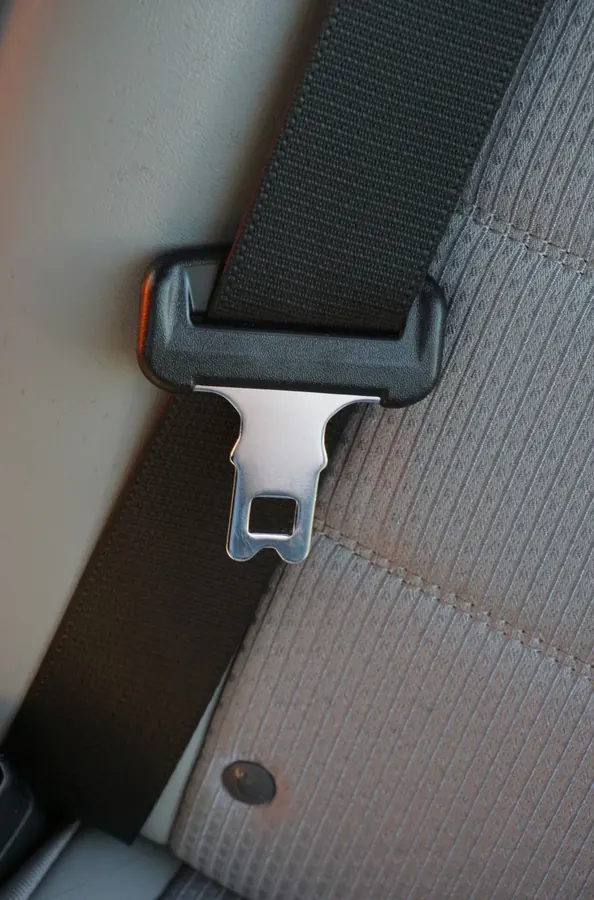
02 Latch plate
Also called the tongue. The metal plate attached to the webbing, which slides into the buckle and is retained there. Three of its properties decide compatibility: the outline of the plate, its thickness, and the position of the slot the buckle mechanism locks into.
Many latch plates have a plastic guide or grip moulded around them, and on some assemblies the plate slides along the webbing rather than being fixed to it. Both details are worth capturing in a photograph.
03 Buckle and receiver
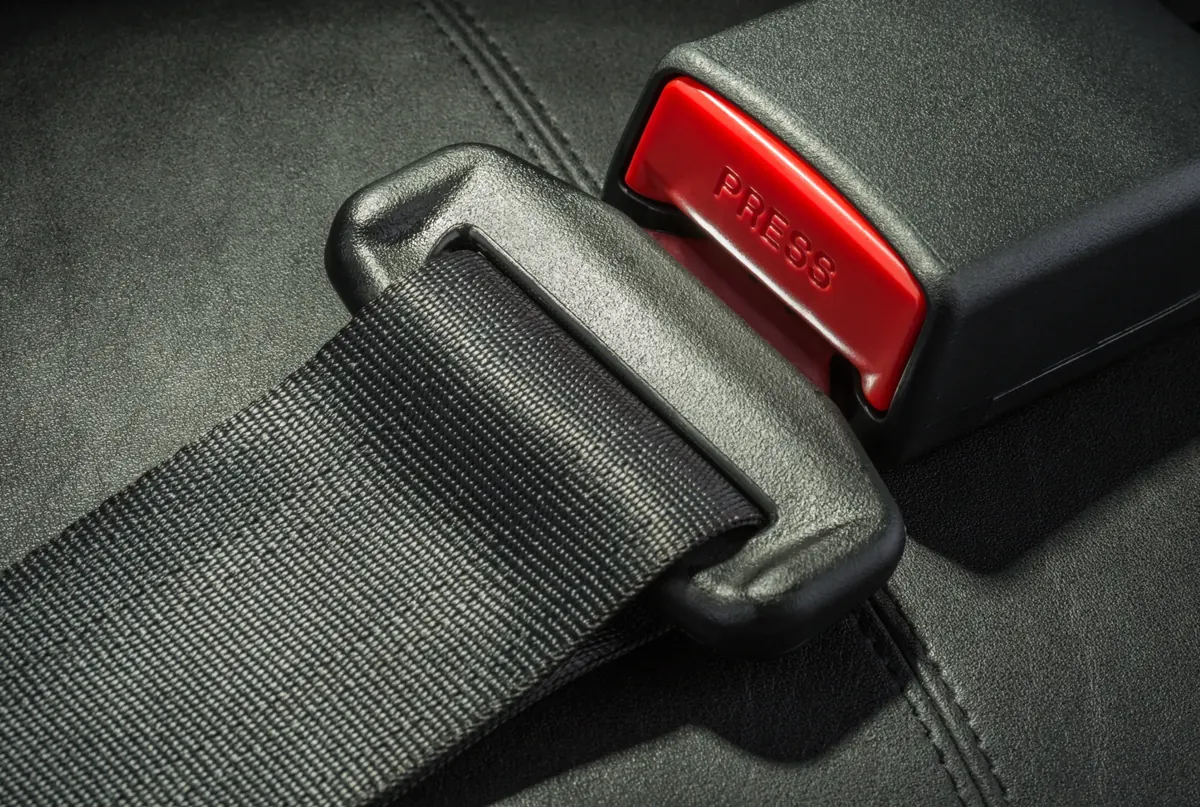
The housing that accepts the latch plate and holds it. “Buckle” and “receiver” both refer to this component; we use them interchangeably, but never to describe the latch plate.
A buckle should take the latch plate with a distinct, positive engagement. Anything vague, intermittent, or position-dependent is an inspection matter. So is a latch plate that can be withdrawn without pressing the release.
How a buckle mounts varies: on a rigid stalk, on a short webbing tail, or directly to structure. That mounting arrangement is part of the compatibility question, not a detail to sort out during fitting.
04 Release button
The control that frees the latch plate, conventionally red so it can be found quickly without looking. It should release cleanly when pressed deliberately, return fully, and not release at any other time.
Buckles fail more often from contamination than from wear — grit, crumbs, coins and spilled drinks all end up in the throat. Clearing debris with dry compressed air or a soft dry brush is reasonable maintenance. Lubricating the mechanism is not: lubricants attract the dust they were meant to displace and can migrate onto webbing.
05 Retractor
On a retractable assembly, the housing containing the spool that webbing winds onto. It pays webbing out as the belt is drawn across and takes it back in when released.
There is no user maintenance here, and the housing stays closed — the internals are under spring tension. What is useful is describing behaviour: does webbing extend smoothly, and does it return fully and promptly? Slow, incomplete or noisy retraction is reported, not investigated.
Two words that are not interchangeable
Retractor is the component. Retractable is a property of the assembly. An assembly is retractable because it has a retractor.
06 Mounting points
The anchorages and hardware connecting the assembly to the vehicle structure. A three-point arrangement uses three; a lap arrangement uses two; a retractable assembly additionally needs a mounting for the retractor housing.
Mounting points belong in any replacement conversation for two reasons. They are a compatibility factor, and they stay in service when the belt is replaced — so their condition affects the outcome. Anchorage hardware should always be fitted and torqued by a qualified automotive technician.
Describing a failure
Put the vocabulary together and a useful description looks like this:
“Rear left position, three-point retractable. The webbing and latch plate are in good condition. The buckle receiver no longer holds the latch plate reliably — it engages but can be pulled out without pressing the release. Buckle is on a short webbing tail mounted inboard of the seat base.”
That description names the position, the configuration, the component that has failed, the component that has not, and the mounting arrangement. It is the difference between an answer and a questionnaire.
Next: when a restraint system should be inspected, which takes each of these components in turn and lists what to look for. If you already know which part you need, the product catalogue is organised the same way.