Frequently asked questions
Seat belt questions, answered plainly
Nineteen questions covering product types, compatibility, inspection and how enquiries work — written to be useful rather than reassuring.
Products & types
Our catalogue is organised into seven groups: car seat belts, three-point seat belts, lap seat belts, retractable seat belts, seat belt buckles and receivers, seat belt accessories, and replacement seat belt solutions. Each group has its own page explaining what it covers and which details decide suitability for a position.
Which group is relevant depends on the belt configuration at the seating position and on whether you need a complete assembly or one part of one.
A three-point seat belt is a lap-and-diagonal arrangement. The webbing runs across the pelvis and diagonally across the chest and collarbone region, and the assembly connects to the vehicle at three points. It is the configuration most commonly found in modern passenger car seating positions.
The diagonal section is what restrains the upper body, which is why a three-point belt and a lap belt are not interchangeable simply because both fasten an occupant.
A retractable seat belt stores its webbing on a spool inside a retractor housing. Webbing pays out as the occupant draws the belt across the body and is taken back in when the belt is released, so the belt sits close to the occupant without manual length adjustment.
Retractable is a description of how the webbing is managed, not of the belt geometry — a retractable assembly can be a three-point or, less commonly, a lap arrangement.
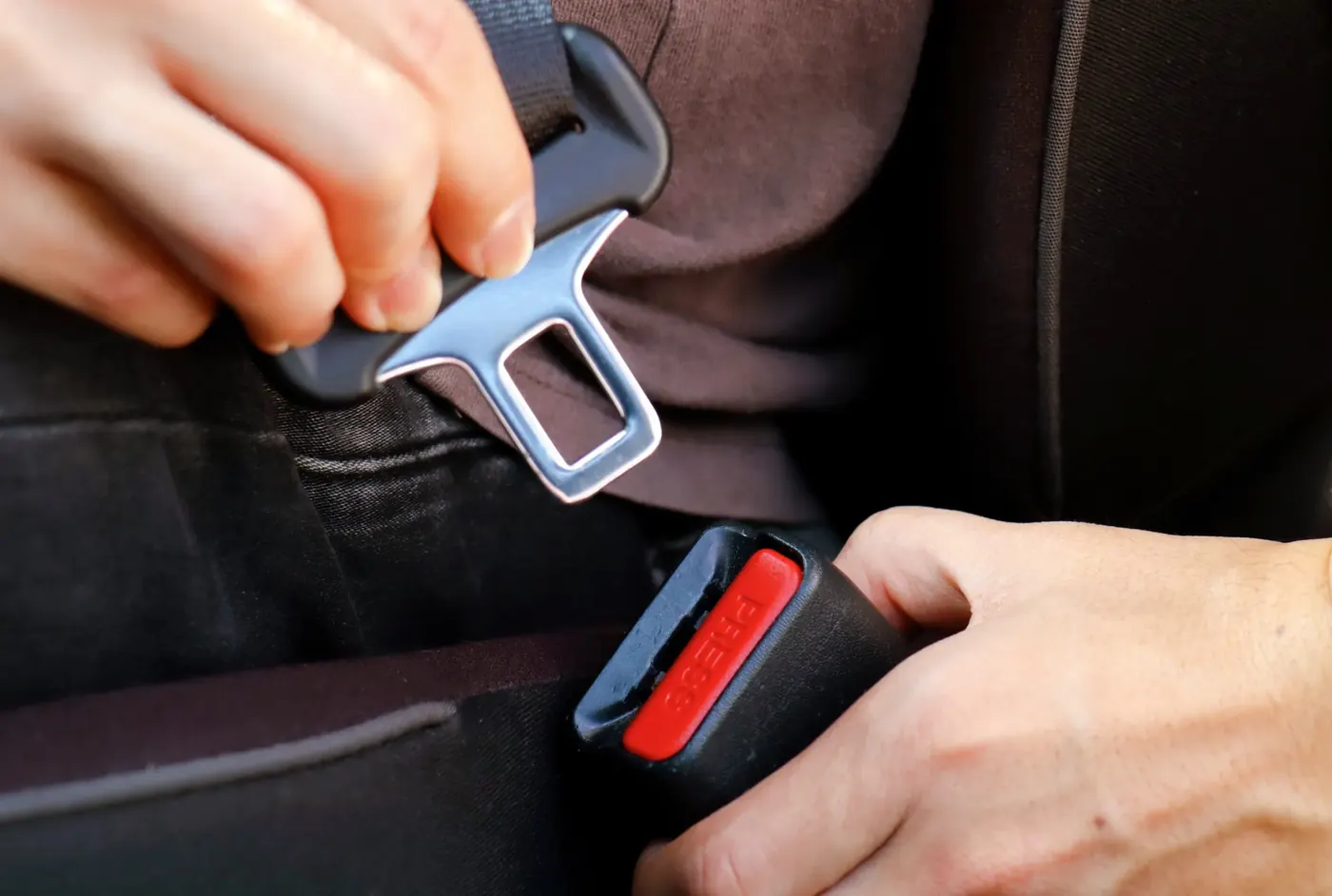
In everyday use the words are often swapped. On this website, the latch plate (or tongue) is the metal plate attached to the webbing; the buckle or receiver is the housing that accepts the latch plate and holds it until the release button is pressed.
When enquiring, describing which physical part you need — the plate on the belt, or the housing it clicks into — is more reliable than the name alone.
Requirements vary, and so does what is available. Some enquiries are for a complete assembly; others are for the buckle side only, or for accessory hardware. Tell us which components you actually need and we will confirm what is available against that requirement.
Compatibility & selection
Work in this order: identify the vehicle and the seating position; establish the belt configuration at that position; decide which components are required; then check the compatibility factors — mounting arrangement, handing, webbing width and latch geometry.
Our Choosing the Right Seat Belt guide walks through each of those steps in more detail, and the enquiry form is built around the same information.
Because a restraint assembly only performs its function if it is the right geometry for the position and is anchored correctly to the vehicle structure. A belt that physically fits through an opening is not the same as a belt that is correct for that position.
Mounting points, handing, latch engagement and webbing dimensions all have to correspond. This is why we ask rather than assume, and why final fitment should be verified at the vehicle.
We confirm what the available information supports. Where compatibility details exist for an item, we share them; where they do not, we say so rather than publishing a fitment claim we cannot stand behind.
For replacement work, photographs of the existing assembly and its mounting points allow a far more useful answer than a vehicle name on its own.
Only where they are actually available for an item. You will not find invented measurements, part numbers or technical data on this website. Product information, including any dimensional detail that exists, is provided in response to an enquiry about a specific requirement.
We do not make certification, approval or safety-test claims on this website. Where documentation exists for a specific product, it is shared as part of the enquiry rather than summarised into a marketing statement. If certification is a requirement for your application, please say so in your enquiry so it can be addressed directly.
Inspection & safety
No. Visible damage to webbing, a buckle that does not latch or release positively, or a retractor that no longer returns webbing are all reasons to have the assembly inspected by a qualified automotive technician rather than left in service.
A seat belt is a restraint component. If there is doubt about its condition, the appropriate response is inspection — not continued use and not a workaround.
General reasons to arrange a professional inspection include: any visible damage or contamination of the webbing; a buckle or release that feels vague, sticky or intermittent; a retractor that does not pull webbing back as it should; unusual noise or resistance when extending the belt; and after any significant impact.
We do not diagnose specific defects remotely. What we can do is help you describe the assembly accurately once a technician has told you what is required.
No — and we will not help with it. We do not supply products or advice intended to bypass, disable or defeat any part of a vehicle safety system, including seat belt warning systems. If a warning system is behaving unexpectedly, that is an inspection matter.
Seat belt anchorages carry occupant load, so installation and anchorage hardware are not general DIY territory. We recommend that fitment is carried out, or at minimum verified, by a qualified automotive technician. That applies equally to a single replacement and to a non-standard installation.
The belt should be worn with the lap section low and snug across the pelvis, the diagonal section across the chest and over the collarbone region, and the webbing flat and untwisted along its whole length. It should not be routed under the arm or behind the back, and nothing should be added that changes how the webbing sits.
Enquiries & ordering
The most useful set is: vehicle type; seating position and which side of the cabin; belt configuration (three-point, lap, retractable); which components you need; quantity; and photographs of the existing assembly and its mounting points if this is a replacement.
The enquiry form on our contact page asks for exactly this, so filling it in is usually the quickest route to a useful reply.
Submit the enquiry form with your details, then email the photographs to info@autogleam.in — or simply email everything together. Photographs of the whole assembly, the latch plate, the buckle and each mounting point cover most questions in advance.
Yes. For multiple vehicles, tell us the number of vehicles, the positions involved and the configuration required, and it can be handled as one conversation rather than a series of separate orders. Consistency of specification across a fleet is usually the more important outcome.
By phone on +91 99206 38354 or by email at info@autogleam.in. Both are also linked in the header and footer of every page on this website.
If your question is not here
Send it through the contact form or call directly. Questions about the condition or function of a restraint system already fitted to a vehicle are best answered by a qualified automotive technician who can examine it.
Read the guides for more depth
Six guide pages cover why restraint matters, belt types, selection, inspection, replacement and care.