
Why Seat Belts Matter
A seat belt is not a strap that holds you in a seat. It is part of a system whose job is to manage where an occupant goes, and how quickly, when a vehicle stops abruptly.
What a restraint system does
When a vehicle decelerates suddenly, everything inside it that is not attached to the structure keeps moving at the speed the vehicle was travelling. That includes the people. The purpose of an occupant restraint system is to couple occupants to the decelerating vehicle rather than leaving them to be stopped by whatever they meet first.
That coupling is what the phrase “occupant restraint” means. The belt is the part you can see and handle, but it works with the seat, the anchorages and the vehicle structure they attach to. Change any one of those and the behaviour of the whole changes, which is why anchorage arrangement matters as much as the belt itself.
A seat belt spends almost all of its life doing nothing visible, and is judged entirely on a fraction of a second it may never be asked to perform.
It follows that a restraint system cannot be assessed by whether it feels fine day to day. A belt that fastens and unfastens without complaint may still have webbing damage along a section you never look at. This is the practical reason for periodic checks rather than waiting for a symptom.
Why positioning matters
The geometry of how a belt sits on the body is not incidental — it is most of the design intent. The lap section is meant to sit low across the pelvis, which is a structure that can accept load. Worn up across the abdomen instead, the same belt presents load to soft tissue.
The diagonal section is meant to cross the chest and pass over the collarbone region. Routed under the arm, it bypasses the upper torso restraint it was designed to provide. Routed behind the back, it provides nothing at all while still allowing the buckle to latch and any warning system to fall silent.

Two more details belong here. Webbing should lie flat: a twisted belt concentrates load along a narrower line than the full width it was designed to spread across. And slack should be minimal — a belt that is loose has to take up that slack before it starts doing anything.
Correct wear, in four points
- Lap section low and snug across the pelvis, not across the abdomen
- Diagonal section across the chest and over the collarbone, never under the arm or behind the back
- Webbing flat and untwisted along its whole length
- No accessory added that changes how the webbing sits against the body
Every seating position counts
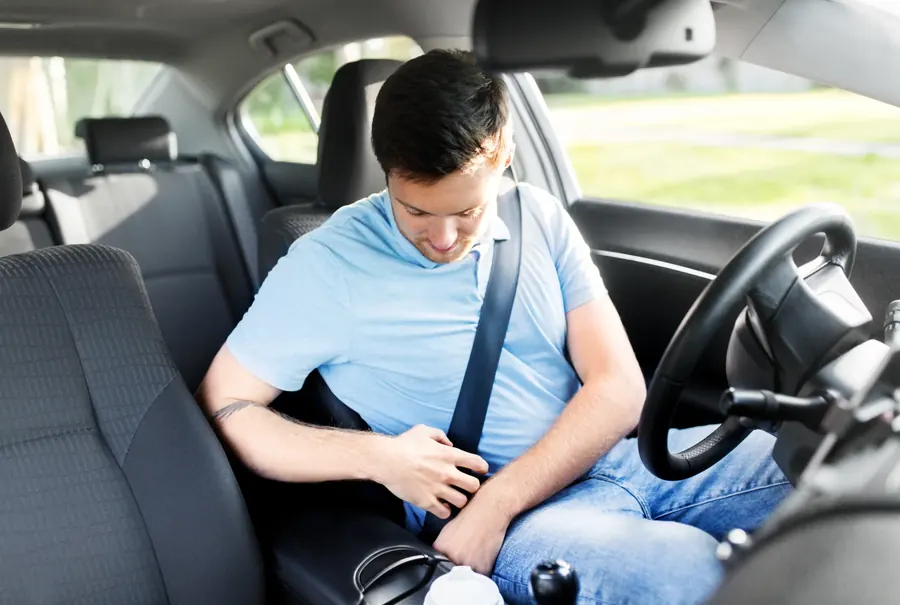
Restraint is a whole-cabin matter. An unrestrained rear occupant is exposed themselves, and also represents a mass moving inside a space shared with everyone else in the vehicle. Where a vehicle provides a belt for a seating position, that belt is there to be used on every journey — including short ones, which is where the habit most often lapses.
This is also why we treat each position as its own requirement when handling enquiries. A rear centre position may use a different configuration to the outboard positions either side of it, and a belt correct for one is unlikely to be correct for another.
Why damage means inspection
There is a specific list of observations that should take an assembly out of the “probably fine” category and into a workshop. Webbing that is cut, frayed, deeply abraded, chemically stained or heat-damaged. A buckle that does not latch with a clear, positive action, or that will not release cleanly when pressed. A retractor that no longer draws webbing back, or does so slowly and incompletely. And any assembly that has been through a significant impact.
None of those are things to diagnose from a photograph or a description, ours included. What they have in common is that the correct next step is inspection by a qualified automotive technician who can examine the assembly and its anchorages at the vehicle.
What not to do
- Do not attempt to repair webbing, splice it, or shorten it
- Do not open a retractor housing — the internals are under spring tension
- Do not dismantle or force a buckle mechanism
- Do not use anything that occupies a buckle to silence a warning system
- Do not leave a suspect assembly in service while waiting for a convenient moment
What to take from this
Three things. First, a restraint system works as a system — belt, anchorages and structure together — which is why compatibility and correct installation are safety matters rather than fitting details. Second, how a belt is worn is part of how it performs, so routing and slack deserve the same attention as the hardware. Third, when something looks or feels wrong, the answer is inspection.
If a technician has told you what needs replacing, the next useful pages are Types of Seat Belts for terminology and Choosing the Right Seat Belt for the order to work in. If you already know the product group you need, go straight to the catalogue.